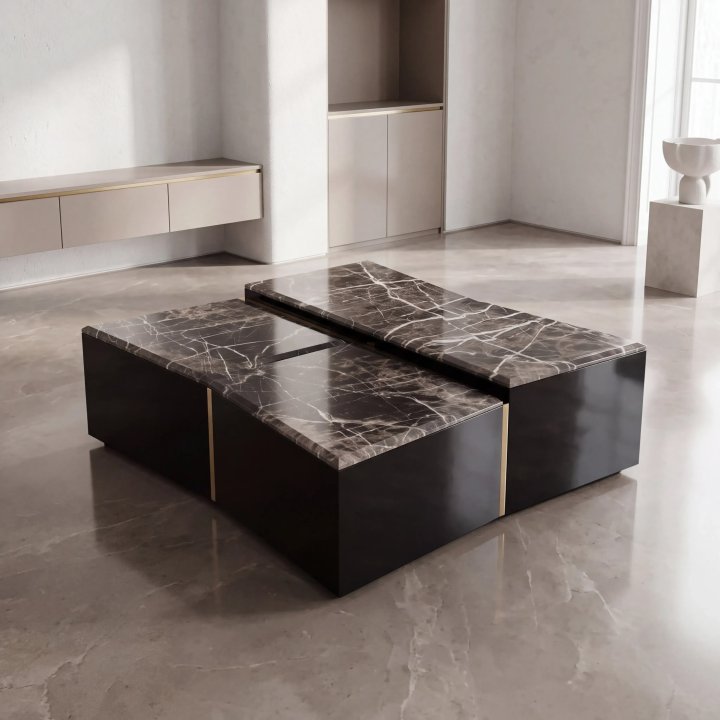
People think that placing a small coffee table in a large living room will make it look more spacious. The exact opposite happens.
Why Is a Coffee Table a More Critical Choice Than You Think?
Proportion to the Size of the Space: The Big Living Room, Small Table Misconception
It's often thought that putting a small coffee table in a large living room will make it "look more spacious." The opposite happens. When the table is too small, it gets lost in the middle of the seating group; the space doesn't feel empty, it starts to feel unfinished. As Istanbul-based interior architect Burcu Yıldırım puts it: "When the table size is chosen wrong, even clearing the room of other furniture won't save it."
There's a simple rule for the right proportion: the table's long side should be about two-thirds of the distance between facing sofas. Anything smaller can't create balance, and anything larger blocks the walkway.
Material choice also factors into this equation. In coffee table models, solid wood or marble surfaces carry visual weight and therefore suit larger spaces better, while glass or metal constructions let smaller spaces breathe. A handcrafted piece also makes a difference here — not just aesthetically, but in long-term durability too. Brands like STARMOBI, which has been manufacturing since 1981 and carries MEP certification, reflect this balance in their collections.
In short: don't choose a table on the logic that "small is harmless." Measure, proportion, then decide.
To find the right model, you can browse STARMOBI's collections or get support from interior-design services.
How Does Material Choice Affect Price? Comparing Wood, Marble, Glass, and Metal
When buying a coffee table, most people look at the price first, but the real question that should be asked is: "What is this price for?" Material choice directly determines both a table's appearance and its lifespan — and, of course, its price.
Wood: The Option That Passes the Test of Time
Solid wood remains the most valuable material in the world of coffee tables. This isn't just about aesthetics — a solid wood table made by a skilled craftsman can be used for decades. There's a fact interior architects often emphasize: handcrafted wood, when compared to a mass-produced piece, turns into a far more economical investment in the long run. It's possible to see this difference firsthand at the manufacturing facilities in Modoko.
Marble, Glass, and Metal: Different Needs, Different Trade-offs
Marble is growing in popularity among premium buyers in Istanbul. Its durability is unquestionable, but its weight and maintenance sensitivity are a downside. Glass tables offer a modern, light look, but their sensitivity to scratching can't be ignored. Metal-framed models, meanwhile, suit industrial-style spaces particularly well — durable, but they can feel cold.
STARMOBI's collections also include hybrid designs that combine each of these materials; wood-metal combinations stand out in particular.
So What Actually Drives the Price Difference?
Craftsmanship quality is as decisive as the material itself. Even when the same wood is used, the difference between a handcrafted table and an assembly-line one is visible to the eye. MEP certification formalizes this distinction — as a criterion documenting manufacturing standards and quality assurance, it's an important reference point for informed buyers. Looking at the material-craftsmanship-design triangle instead of the price tag when choosing the right table ensures you won't have regrets in the long run.
If you'd like professional guidance on this, you can use interior-design services to determine, together, the model best suited to your space. We recommend visiting STARMOBI to browse the full collection.
Solid Wood: Why Is It the Smarter Long-Term Investment?
There's something I often tell clients in interior-design projects: "I bought it cheap, and it cost me dearly." That line perhaps shows up nowhere more than in the choice of a coffee table.
The price of a table made from solid wood is noticeably higher than a chipboard or MDF option of the same size. That difference reflects the labor that goes into processing, drying, and shaping the material used. When craftsmanship enters the picture, the price gap widens further — and it's not entirely an unfair gap.
As an interior architect, I can say this plainly: solid wood is the only material that doesn't change shape over the years, whose surface can be repaired, and that doesn't look "old" even decades later. Glass breaks, marble cracks, metal paint fades. Wood, on the other hand, settles in over time and gains character.
When comparing coffee table models, the question to ask is: will this piece of furniture still be in my home five years from now, or will I have to replace it? The answer to that question usually points to solid wood.
STARMOBI's collections include this kind of model — especially in pieces manufactured under MEP certification, material quality and craftsmanship standards are kept at a documented level. That's an important assurance for premium buyers in Istanbul.
In short: solid wood may feel like more of an expense today, but in the long run, the math is mostly in its favor.
If you'd like to discover the right collections or make a choice tailored to your home, you can get support from STARMOBI's interior-design services.
What to Watch For with Marble and Glass Tables
Marble and glass coffee tables are among the top choices in many interior-design projects in Istanbul — but both materials deserve more thought than they might seem to at first glance.
Marble carries incredible character in the right setting. However, because of its porous structure, limescale marks, acidic-drink stains, and color changes over time can turn into a serious maintenance burden. Interior architects tell families with children in particular: "think about ease of maintenance first." What's more, marble tables are quite heavy; moving them becomes a real task if the layout changes.
With glass tables, the real issue is thickness and edge finishing. Thin glass is far more fragile in everyday use. Models that combine tempered glass with a metal construction significantly reduce this risk. STARMOBI's collections include models that pay careful attention to these kinds of details.
For both materials, what determines the price isn't just the raw material — craftsmanship quality, surface finishing, and construction design shape the table's actual lifespan. If you're looking for long-term value, professional interior-design consulting makes a real contribution to matching the right material with the right space.
If you'd like to take a closer look at marble and glass models and see different options side by side, you can discover coffee table and side table models at STARMOBI.
Mass Production or Handcraftsmanship? An Honest Comparison of Two Manufacturing Models
I've heard this question many times in interior-design projects: "They're both wood, they both look nice — what's the difference?" The difference is actually huge, but it's not visible at first glance.
Mass-produced tables are offered at consistent, accessible price points because they're made with standard dimensions and machines. A practical choice in the short term. But material quality usually stays at a mid level; surface coatings can wear out under heavy everyday use. With handcrafted tables, the story is different: materials like solid wood, marble, or forged metal are shaped by the craftsman's hand. This process takes time and shows up in the price — but the resulting product can last a decade or more.
Established brands operating under MEP certification and manufacturing since 1981 know this difference very well. STARMOBI is one of the standout options right at this point — the emphasis placed on craftsmanship and quality material in its coffee table collections is directly reflected in the product's lifespan.
The vast majority of premium buyers in Istanbul today are no longer concerned with "buying cheap" but with "buying right." And from an interior architect's perspective, one correct investment made once is far more sensible than an incorrect purchase repeated two or three times.
In the end, the choice is yours — but when you factor in long-term value, craftsmanship and solid material win out almost every time. You can start finding the model best suited to your living space by browsing STARMOBI's collections.
How Can You Spot Quality Craftsmanship by Eye? 5 Questions to Ask at the Showroom
It's very easy to get lost among dozens of models when you walk into a showroom. The price tag catches your eye, the color is likable, the dimensions fit — and the decision gets made. Yet the real question is: what will that table look like five years from now?
From an interior-design perspective, a table's quality often doesn't reveal itself at first glance, but when the right questions are asked. Here's what you should be sure to ask at the showroom:
- "Is the wood solid or veneered?" Solid wood gains character over time; a good veneered product isn't necessarily cheap either — but choosing without knowing the difference is risky.
- "What kind of joinery is used?" Screws, mortise-and-tenon, or glue? Hand-crafted mortise-and-tenon joints last for decades.
- "Where is it manufactured?" The difference between mass production and workshop production shows itself especially in the precision of material processing.
- "What was used for the surface finish?" Polishing, oiling, or lacquer — each has a different maintenance need and lifespan.
- "Can the design be customized?" Brands that offer interior-design services will give a clear answer to this question.
If you're looking for long-term value, craftsmanship and a wood-forward structure are, in fact, the soundest investment. MEP-certified manufacturers are required to meet these standards — an important assurance for the buyer. STARMOBI's collections include models that meet these criteria; you can see the difference for yourself by browsing the coffee table options.
Standout Coffee Table Models and Design Trends in 2026
In 2026, interior-architect preferences and consumer demand have converged: there's simplicity, but nothing ordinary. Natural materials — especially solid wood and marble — have returned to the center of living rooms. Alongside them, glass and matte-metal combinations remain popular for those seeking a younger, more urban aesthetic.
Design-wise, single-piece minimal forms are still in fashion, but it's worth noting that what makes the real difference is in the details. Hand-carved work, joinery technique, or special surface finishes — these are the clearest markers that set a piece apart from mass production. When you look through STARMOBI's collections, you can see this approach in concrete form: material choice and craftsmanship quality take center stage in every model.
For premium buyers in Istanbul, the real question is: "Will this table still look the same five years from now?" Solid wood is one of the few materials that can give a clear "yes" to that question. The price gap may look large at first, but when you're buying a piece that holds its value over the long term, the math starts to work out.
Multi-functional models are also drawing attention in 2026: structures with storage compartments, adjustable height, or modular builds offer a practical solution, especially for smaller apartments. It's worth taking a look at these multi-functional models as well when reviewing coffee table and side table options.
Conclusion: Choosing the Right Coffee Table Is an Investment Decision
At first glance, choosing a coffee table might seem like an ordinary furniture purchase. But when it comes to a piece that sits right in the middle of the living room, catches your eye every day, and shapes the overall feel of the home, it makes sense to think the decision through a bit more.
Material quality, craftsmanship, and design originality — each of these directly affects both the price and the useful life. The difference between mass production and craftsmanship shows itself as the years go by.
STARMOBI, which has been manufacturing since 1981, has grown from its first showroom opened in 1990 to today, moved to Masko in 1998, and now operates under the umbrella of MEP certification, reflects this experience in its products.
If you're having trouble deciding which model suits your home, you can make use of interior-design services. An eye that knows your space makes the choosing process considerably easier.
To browse STARMOBI's full collection and see the 2026 trends up close, you can visit the store or review the online catalog.
Güncellendi: Ekim 2026