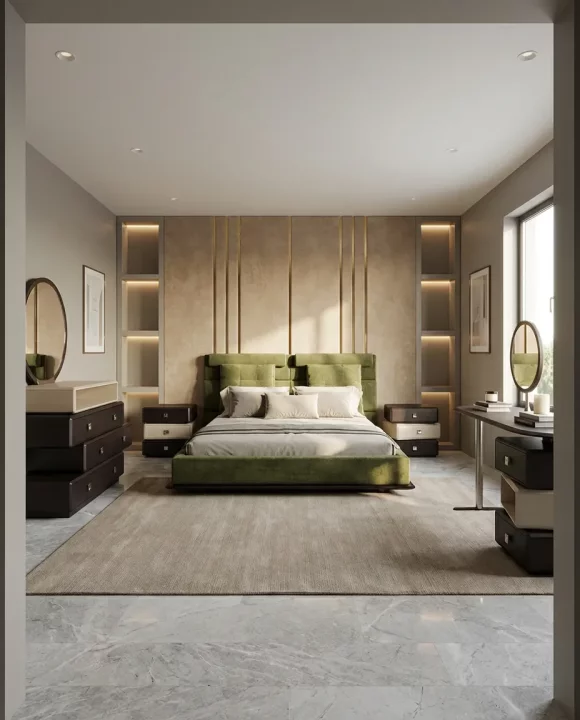
For an interior designer looking for a contract furniture manufacturer in Türkiye, the hardest part of the job is not finding a beautiful product.
For an interior architect looking for a project furniture manufacturer in Turkey, the hardest part of the job isn't finding a good-looking product. The real question is whether that product will arrive on site looking like it did in the drawing, on the promised date, and in the requested dimensions. Twenty sofas to be used in a villa living room or a hotel lobby aren't chosen with the same logic as a single sofa for your own home. With the former, the supply chain, the fabric batch, technical drawings, sample approval, and the shipping plan all come into play.
That's why the things interior architects look at when choosing a manufacturer spread across a much broader list than the photo in the catalog. Does the manufacturer have its own workshop? How far can it flex on custom dimensions? What do its material options consist of? Has it delivered work at a similar scale before? Each of these directly affects the project's budget, its timeline, and ultimately the client's satisfaction.
In this guide, we pull together the selection criteria in plain language for interior architects and project developers who'll be sourcing furniture for villa, residence, hotel, and commercial-space projects. We'll cover the difference between a supplier selling ready-made collections and a project-focused manufacturer, the technical-drawing and sample process, what to watch for on the material side, and schedule and shipping coordination. We'll also touch on why seeing materials in person at the showroom matters, and how after-sales communication affects a project. As we go, we'll occasionally give examples of how STARMOBI responds to these criteria, but the aim isn't to produce a brand ranking. The aim is to make it easier for you to ask the right questions for your own project.
What Is Project Furniture, and Why Do Interior Architects in Turkey Want to Work with the Manufacturer?
Project furniture means furniture prepared for a specific space, according to that space's dimensions, usage intensity, and design language. Whether it's a residential, hotel, residence, or commercial space, the common point is that the products aren't picked off a shelf — they're planned and produced according to the project. A ready-made-collection supplier offers the models it has on hand, and you choose from among them. A project-focused manufacturer, on the other hand, runs a process that starts with a drawing and ends with production.
Why the Manufacturer, Not an Intermediary?
The interior architect usually has a clear concept in hand: this fabric, this wood tone, this seat depth. When an intermediary steps in between, that information passes through several hands and small deviations grow. When talking directly with the manufacturer, a dimensional change, a material alternative, or a detail revision can be settled within the same day. With firms that have their own manufacturing facility — that is, those that don't outsource the work — quality control and schedule tracking are also much easier.
STARMOBI's history offers an idea on this front. The firm, which started manufacturing in 1981, opened its first showroom in 1990 and entered Masko in 1998 to begin operating under the MEP umbrella. Today the showroom side runs in Masko, and the manufacturing side at the Modoko facility. For interior architects, the practical meaning of this is: even though the place that displays the product and the place that makes it are separate, they're talked about under the same roof. You can also find information about MEP certification on the firm's website.
Those curious about what project-based work looks like can browse the completed projects page. For those who want to look at ready-made models, the collections section is a good starting point.
The Difference Between Retail Shopping and Project Sourcing
Furnishing a home and outfitting a hotel or a residence aren't the same job. In retail, the customer walks into the showroom, picks the sofa they like, pays, and the product comes home. In project sourcing, there's generally an interior architect, an implementation schedule, and often dozens of different spaces involved. The first thing interior architects in Turkey separate out when choosing a manufacturer is this: is the firm across from them just selling products, or can it run the project together with them?
What Does a Ready-Made-Collection Supplier Offer?
At firms selling ready-made collections, the product is fixed. Dimensions, fabric options, and the color palette stay within the catalog. In a small residential job, that may be enough. But if the living room in a villa is 6.5 meters wide, or the sofa's height in a hotel lobby needs to be adjusted to the railing line, catalog dimensions become useless.
How Does a Project-Focused Manufacturer Work?
A project-focused manufacturer, on the other hand, starts with the interior architect's drawing. A technical drawing is prepared, a sample is made, the fabric or leather is approved, and then mass production begins. Firms with their own manufacturing facility keep this chain under one roof, so no third party steps in between when a change is needed. STARMOBI is one of the manufacturers working with this approach. The manufacturing side runs at the Modoko facility, while those who want to see the products go to the Masko showroom. They're separate places, but parts of the same flow.
- Dimensions and design: Fixed in retail; shaped by the space in a project.
- Schedule: In a project, delivery is planned according to progress on site; an order can be shipped in stages rather than all at once.
- Point of contact: In retail, a sales consultant; in a project, a team that knows production and works together with the interior architect.
- References: In a project, a firm's previously completed work can be reviewed, for example from pages like its project work.
The matter of trust comes into play here too. Knowing that STARMOBI started manufacturing in 1981, opened its first showroom in 1990, and entered Masko in 1998 to begin operating under the MEP umbrella makes it easier for an interior architect to see the firm's history in the industry. Of course, it isn't a sufficient criterion on its own; but it gains meaning when evaluated alongside conversations about samples, technical drawings, and schedules.
In short, the difference is this: retail is choosing what's ready, while project sourcing is producing together what suits the space. That's why an interior architect looks at the manufacturer's flexibility and coordination skills before the price list.
If you have a project and want to talk about dimensions, materials, or schedule, you can get in touch with STARMOBI or visit the Masko showroom to see samples up close.
The Strengths of Project Furniture Manufacturing in Turkey
When project furniture is mentioned in Turkey, the first thing that comes to mind is that so many stages of manufacturing can be gathered under one roof. In a villa, residence, or hotel project, a piece the interior architect has drawn coming to life in the workshop proceeds much more easily in a setup with few intermediaries. Many of the criteria interior architects look at when choosing a manufacturer come from here.
Own Manufacturing Facility and Flexibility
Firms that manufacture at their own facility can respond to dimensional and detail changes faster. Changing a sofa's seat depth or choosing a different metal finish for a table leg is hard in a ready-made-collection logic; with a project-focused manufacturer, it's an ordinary request. STARMOBI continues its manufacturing history that began in 1981 at the Modoko manufacturing facility today, and uses this flexibility in project-based work with interior architects.
Material Variety
In Turkey, manufacturers can reach a wide range of materials like Italian fabric and leather, solid and veneered wood, marble, and metal. For the interior architect, this means not having to trim the concept because of material. The sample and technical-drawing stage gains importance here too: deciding without holding the fabric, leather, or marble in your hand is often a risk. STARMOBI, which opened its first showroom in 1990, offers the chance to see materials and products in person today at its MEP-certified Masko showroom. The firm has operated in Masko, under the MEP umbrella, since 1998.
Ready-Made Collection, or Project-Focused Manufacturer?
A ready-made-collection supplier delivers the catalog product from stock or in a short time; it may be enough for a single apartment or a small space. But in jobs where hundreds of pieces need to be cohesive, like hotel rooms or a residence's common areas, the project-focused manufacturer stands out. Because custom dimensions, repeated production, and the delivery schedule only run smoothly with someone who manages the production. Still, not every project may require designing from scratch; STARMOBI's collections, and among its sofa sets, include models that can be worked into a project through dimension and fabric adaptation.
Schedule, Shipping, and References
The place where the most problems usually arise in project furniture is timing. Production and shipping going in coordination is essential so that other work on site doesn't stall either. Manufacturers with domestic and export experience know how to plan shipping to different locations, so they move more comfortably on this front. That's why interior architects look separately at completed-project references and after-sales communication.
If you have a project, you can get in touch with STARMOBI along with your drawings, or visit the Masko showroom to examine the materials up close.
Ready-Made-Collection Supplier, or Project-Focused Manufacturer?
Every interior architect who starts looking for project furniture runs into the same question: should I work with a supplier I'll pick from a catalog and order from, or with a firm that manufactures per project? Neither is wrong. The right answer depends on what the project needs.
When Does a Ready-Made-Collection Supplier Work?
The products are ready, price and visuals are set, and delivery is generally fast. For a single apartment or a small office, this is a practical path. But when the dimensions don't match, when you want to change the fabric, or when you need to make the same product in different sizes for all the hotel's rooms, things get hard. The catalog draws you a limit, and stepping outside that limit is often not possible.
What Does a Project-Focused Manufacturer Do Differently?
In villa, residence, hotel, or commercial-space projects, furniture is often shaped by the space. In such a manufacturer, having its own manufacturing facility makes a big difference, because dimensional changes, custom design, and the sample stage are all managed under the same roof. The interior architect sends the technical drawing, the sample comes out, approval is given, and then mass production begins. With no intermediary, the misunderstandings that creep in between are reduced too.
STARMOBI is one of the manufacturers that can be described in this second group. It works project-based with interior architects, and has experience on the export side as well as domestically. Its manufacturing history extends back to 1981. The first showroom opened in 1990; in 1998 it entered Masko and began operating under the MEP umbrella. Manufacturing takes place at the Modoko facility, while Masko is the showroom where you can see the products and materials up close.
A Practical Method for Deciding
- Are there custom-sized or custom-design pieces in the project?
- Will the same product repeat across multiple units (like hotel rooms or residence apartments)?
- Does the schedule leave time for sample approval and shipping coordination?
If most of the answers are yes, a project-focused manufacturer makes more sense. If you want to see a ready-made starting point, browsing the collections gives an idea too; because a good project manufacturer's collection can also be used as a jumping-off point for custom work.
The Pros and Cons of the Ready-Made Collection Model
When interior architects look for a manufacturer for project furniture, they first ask this question: are we going with a ready-made collection, or will we have it produced specifically for the project? Both have their place. The matter is seeing from the start which suits which project.
The Strengths of a Ready-Made Collection
Choosing from a catalog speeds up the work. The product is pre-designed and tested, and its photo, dimensions, and fabric options are all out in the open. When preparing a presentation for the client, it's easy to say "this is exactly what you'll see." For a small office, a single apartment, or a commercial space on a tight budget, this path is often sufficient. Because the manufacturer already works in series, the process is also less complicated. STARMOBI's collections include this kind of ready-made model, and they can be seen in person at the showroom.
The Shortcomings
- Dimensional limits: A size that would fit a narrow lobby or a curved living room usually isn't in the catalog.
- Difficulty standing out: The same model can show up in other projects too. For a hotel or residence seeking a distinctive identity, this is annoying.
- Detail flexibility: Small interventions like stitching type, leg material, or upholstery ratio aren't always possible.
Where's the Difference with a Project-Focused Manufacturer?
A project-focused manufacturer treats the collection as a starting point. It changes the dimensions, chooses the material per project, and carries out the technical-drawing and sample stage together. With firms that manufacture at their own facility, this work flows more easily, because you can pass the change directly to the team at the factory. STARMOBI's manufacturing history that began in 1981 and its project work carried out with interior architects are examples of this approach; some of the work it has done can be viewed on the projects page.
A practical distinction can be made like this: for individual spaces and clear budgets, a ready-made collection does the job. In repeating jobs that involve custom requests — like a villa, a hotel, or a multi-unit residence — the flexibility of custom production often becomes more important. That's why many interior architects mix the two methods in the same project; using custom production in common areas and ready-made models in the secondary rooms.
Talking through your needs with a manufacturer before deciding which path to take makes the work easier. If you'd like, you can request a project meeting through the contact page, or visit the Masko showroom to examine the products and materials up close.
What Does a Project-Focused Manufacturer Do Differently?
In a villa or hotel project, the furniture list often isn't made up of standard products. The living room needs a slightly deeper seating group, the lobby needs a specific marble top, and the rooms need headboards that fit the layout plan exactly. A supplier selling ready-made collections has to settle for the catalog's dimensions at this point. A project-focused manufacturer, on the other hand, redraws the dimensions according to the project.
The Ready-Made-Collection Supplier vs. the Project Manufacturer
The advantage of a ready-made collection is quick decision-making. You see the product, you place the order. But if the dimensions, fabric, or leg detail are going to change, things get hard. With a project manufacturer, the order flips: the interior architect's drawing comes first, and the product is shaped accordingly. That's why interior architects generally look at the answers to these questions:
- Is production done at its own facility, or is the work outsourced?
- Is it open to custom-sized and custom-design requests?
- How does it run the technical-drawing and sample stage?
- Does it offer options in materials like Italian fabric and leather, wood, marble, and metal?
- Can it plan production and shipping around the project schedule?
From the Drawing on Paper to the Site
The clearest benefit of working with a firm that manufactures at its own facility is fast revision. If a proportion in the sample looks wrong to you, you can talk with the workshop within the same week. STARMOBI is one of the manufacturers working in this arrangement; its manufacturing side runs at the Modoko facility, and under its interior-design service it can accompany the project from the drawing stage onward. The fact that production started in 1981 also shows there's accumulated experience on this front.
Seeing the material with your own hands also eases the decision. There can be a difference between a leather tone on screen and its real look in the showroom. STARMOBI's showroom in Masko is useful for exactly this reason; together with the client, you can examine samples and products in person. The firm's first showroom opened in 1990, and it has operated in Masko, under the MEP umbrella, since 1998. These three dates describe separate periods, but together they point to a long history in the industry.
References and After-Sales
Completed work shows what a manufacturer does in the field, not in words. That's why interior architects generally prefer to look at completed projects. Having an accessible point of contact for the small corrections or missing parts that come up after delivery is at least as important as production quality. On large projects, this communication determines how the job ends.
If you'd like to talk through production and material options for your project, you can get in touch with the STARMOBI team or visit the Masko showroom to see the products in person.
The Advantages of Choosing a Furniture Manufacturer with Its Own Manufacturing Facility
In project furniture, the fate of the job is often determined at the factory. When placing an order for a hotel lobby or a series of residence apartments, knowing whose hands the product is in and which stage it's at provides serious peace of mind. This is also where the most concrete benefits of choosing a furniture manufacturer with its own manufacturing facility begin for interior architects.
Fast Response to Dimensional and Design Changes
Revisions in a project are not a surprise, but the rule. The wall dimension shifts, the client wants to change the fabric, the sofa's seat depth is revised at the last minute. If production is outsourced to another firm, every change turns into a chain of correspondence. With a manufacturer that has its own workshop, the team that makes the drawing and the team that makes the product are under the same roof; decisions are made fast, and samples come out sooner. This is why custom-sized and custom-design requests are often met more comfortably in this structure.
Quality Control and Command of Material
Whether it's Italian fabric, leather, a wood frame, marble, or a metal detail, if the material can be checked as it enters the production line, the chance of surprises later drops. For the interior architect, the real issue is receiving an exact match of the sample they approved. A firm that keeps production in its own hands doesn't have to chase this — it's already inside the process.
Schedule and Shipping Coordination
In hotel and commercial-space projects, delivery doesn't finish in one go; it proceeds floor by floor, section by section. A firm that manages its own production plan can adjust batches according to progress on site. Providing this flexibility is harder in a structure that sources from outside.
STARMOBI is one of the manufacturers that can be given as an example at this point. Its manufacturing history that began in 1981 continues today at the Modoko manufacturing facility; its first showroom opened in 1990 and its entry into Masko in 1998 with operations under the MEP umbrella offers, alongside manufacturing, the ability to show material and product in person. The interior-design service designed for interior architects also works together with this manufacturing infrastructure. The work done can be viewed on the projects page, and models in categories like sofa sets can be browsed through the collections.
If you'd like to have a preliminary conversation for your own project or see the materials with your own hands, you can visit the Masko showroom, or plan a project meeting with the STARMOBI team through the contact page.
Production Control, Quality, and Ease of Revision
In project furniture, the real work begins after the order is placed. In large jobs like a villa or a hotel, the moment an interior architect struggles most is noticing on site that a detail in production came out different from the drawing. That's why, when choosing a project furniture manufacturer, everyone asks the same question: who does the manufacturing, and where can I have a say?
Being Able to See Production Up Close
With firms that manufacture at their own facility, the process moves more transparently. Because the frame, upholstery, and paint stages are under the same roof, when a problem arises the point of contact is clear. With a supplier selling ready-made collections, the product is generally fixed. When you ask for a dimensional or fabric change, things drag on. With a project-focused manufacturer, the sample, technical-drawing approval, and mass production run as separate steps. At STARMOBI, production is built on the experience that began in 1981 and takes place at the Modoko manufacturing facility. Interior architects can ask what stage a product is at.
Quality and Revision
When quality is mentioned, material comes to mind first, but the evenness of the stitching, the firmness of the seat, and the sturdiness of the wood frame are equally important. You need to see these on a sample, not on paper. The Masko showroom is useful for this reason. You can feel the fabric, leather, or wood with your hand and decide together with the client. On the showroom and certification side, MEP certification also gives an idea about the firm's corporate structure. The firm, which joined Masko in 1998, operates under the MEP umbrella.
Revision should be looked at honestly too: in no project does everything land on the first try. The client changes the color, the architect shortens a dimension, the wall on site turns out different than expected. What matters is that the manufacturer can absorb this change. If a small dimensional correction requires going back into production from scratch, the schedule quickly falls apart. A firm doing custom production can catch these kinds of corrections at the drawing stage. For example, with products like sofa sets, where dimensional and upholstery differences are strongly felt, going by an approved sample saves serious time.
- The ability to follow production stages and get photo updates
- Sample and drawing approval before mass production
- A clear communication line that's open to revision requests
- Pre-delivery inspection and a packaging routine
Conclusion
Looking at the criteria interior architects in Turkey consider when choosing a manufacturer as a whole, a common conclusion emerges: a good-looking catalog alone isn't enough. A firm that manufactures at its own facility, is open to custom dimensions and design, and takes the technical-drawing and sample process seriously makes a much easier business partner throughout the project. A wide range of material options (Italian fabric and leather, wood, marble, metal), fit with the schedule, shipping coordination, and references from completed work also sit near the top of the list.
The difference between a ready-made-collection supplier and a project-focused manufacturer shows up here too. A standard product may look like a quick solution. But when it comes to a space with set dimensions and character, like a hotel room, a residence lobby, or a villa living room, flexibility and ease of revision are often more decisive. After-sales communication is the criterion most people leave for last but actually remember the most.
If you'd like to see how these criteria are met at STARMOBI, you can look at completed work on the projects page and review the available models in the collections section. For the approach of working together with interior architects throughout the process, the interior-design service page may also be useful.
If you have a project, the best step is to start the conversation together with your drawings. You can reach us through the contact page for a project meeting, or visit the Masko showroom and see fabric, leather, and wood samples up close.
Güncellendi: Ekim 2026