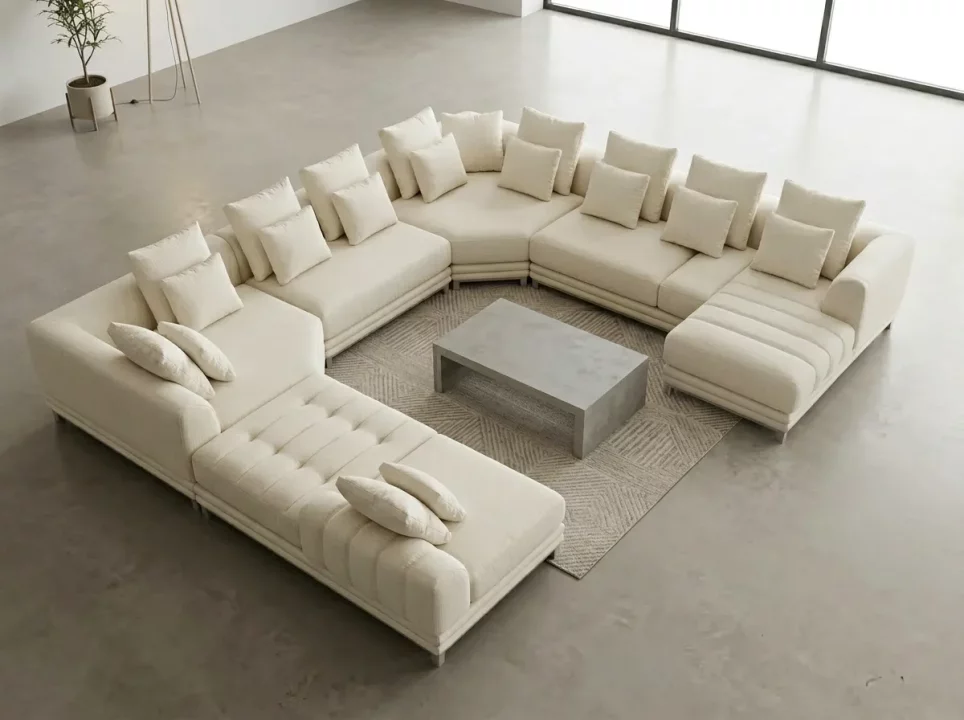
A velvet, bouclé, and chenille sofa fabric guide helps you figure out whether a texture you'd love to run your hand over in the store will also suit everyday life at home. Because choosing fabric isn't just about liking a color.
A velvet, bouclé, and chenille sofa fabric guide helps you figure out whether a texture you'd love to run your hand over in the store will also suit everyday life at home. Because choosing fabric isn't just about liking a color. The corner sofa where you stretch out and rest in the evenings, the living-room set where you host guests, and the single armchair by the window all have different needs. Even two fabrics that look similarly soft at first glance can behave differently under light, in long-term use, or during cleaning. That's why, when deciding, you need to think about the texture, how often it's used, and the time you can spare for care, as much as the look.
Velvet stands out with the soft surface formed by its short, dense pile. Depending on the direction of the pile and the angle the light comes from, the same color sometimes looks darker and sometimes lighter; sitting marks can also come from this change of direction. Bouclé, on the other hand, offers a more pronounced, raised surface with its texture made of looped, small curls. It especially adds movement to simple furniture lines; but not every bouclé has the same softness. Chenille gives a full, warm touch thanks to its fuzzy yarn structure. It can appeal to those seeking a calmer look; the tonal transitions on its surface vary depending on the weave. For all three options, the name of the fabric alone doesn't explain quality or durability.
The real difference is determined by the fiber content, weave density, yarn structure, and any surface treatments. How easily a stain cleans, the wear caused by friction, and pilling — seen as small fiber balls on the surface — should be evaluated separately. A soft fabric isn't necessarily delicate, and a fabric that looks thick isn't automatically considered suitable for heavy use. In homes with children, ease of dealing with spilled drinks stands out; in homes with pets, cleaning hair and the chance of claws snagging on the surface come to the fore. In living rooms that are used less often, more weight can be given to the texture's visual effect. The goal here is to find a surface you can use comfortably with your daily habits.
Color choice is part of this evaluation too. Light tones can give a lighter look on large surfaces, while dark tones increase the sofa's weight in the room. Mid-tones and textured surfaces can make some everyday marks less noticeable; still, no color hides every stain. When evaluating STARMOBI's sofa sets, thinking about the fabric together with the curtains, rug, and floor is a healthier starting point than liking a single sample on its own. In this guide, we'll compare the comfort, care needs, and suitability for different uses of the three textures, looking at points that will make your choice easier. We'll also factor in that a texture that looks nice on a small sample may feel more dominant on a large sofa.
Where Should You Start When Choosing Sofa Fabric?
First describe the sofa's daily use: Is time spent on it every evening, do the kids play here, does your pet sleep in the same corner? In heavily used living rooms, give priority to fabrics with clear cleaning instructions, a tight weave, and a stated suitability for the intended use. Chenille's full feel can suit daily relaxation, velvet's light-shifting surface can suit living rooms where visual impact is sought, and bouclé's raised texture can suit a simple-lined armchair. These aren't firm boundaries; suitability depends on the fabric's own properties.
In homes with children, the method for dealing with stains is especially important. In homes with pets, evaluate bouclé's looped surface carefully with regard to claw snagging. On velvet, the pile direction can make sitting marks more visible; on chenille, surface changes due to friction may be seen. Don't infer the tendency toward fuzzing and pilling from the fabric type alone. At the time of sale, ask about the sample's fiber content, care conditions, and, if available, test information. Looking at how the surface recovers when you press down with your hand and let go also helps you get to know the texture; this observation doesn't replace technical tests.
The Martindale test is used to assess a fabric's wear resistance against repeated friction. Don't read the result on its own as a guarantee of stain resistance, resistance to claws, or no pilling. Especially in wide-seat corner sofa models, evaluate both the durability information and the feel the texture gives in long-term contact. On large surfaces, the effect of color grows too; if possible, examine the sample in daylight and under evening lighting.
Seeing and touching the fabrics at STARMOBI's Masko showroom lets you notice differences that can't be understood in a photo. Evaluating the room's light, dimensions, and existing furniture together under interior-design services can also make your decision easier. Examine the sample both horizontally and vertically; especially on velvet, check for the tone difference that arises from viewing angle. A color that looks strong on an armchair can appear more dominant than expected on a large sofa.
For care, with a suitable head for the fabric, regular vacuuming at low suction is a good start. Blot spilled liquid with a clean, absorbent cloth without rubbing. Before applying a cleaner, review the use and care instructions; test the permitted product on an unseen spot. Reduce long exposure to direct sunlight.
To evaluate velvet, bouclé, and chenille options together with the sofa models, visit STARMOBI's Masko showroom. By touching the fabrics and evaluating them together with an interior architect, you can choose the texture you'll use comfortably at home.
The First Differences Between Velvet, Bouclé, and Chenille
The easiest way to tell these three fabrics apart is to run your hand over them first. To the eye, they all look "soft and comfortable," but the difference is immediately clear when you touch them.
Velvet: A Smooth Surface That Plays with Light
Velvet has a short, dense-piled surface. When you run your hand in one direction, it shines; when you run it the opposite way, it looks matte and dark. That's why the same sofa can look like one color in daylight and another under yellow evening light. In deep tones like navy or emerald green, this effect works beautifully. If you're after visual impact in the living room, velvet is generally the first thing that comes to mind. Its care takes some attention; crushing marks can remain, and regular brushing makes the job easier.
Bouclé: Curly, Textured, and Suited to Rounded Lines
Bouclé has a curly yarn made of loops. Its surface is puffy and a bit reminiscent of lambskin. Its color barely changes with light; instead, the texture comes to the fore. It looks very good on single armchairs and curved-lined sofas. But the loops can snag on claws, a pet's paw, or something hard like a zipper. Don't cut a pulled loop; pushing it inward is safer.
Chenille: Soft, Enveloping, Comfortable
Because the yarn itself is fuzzy, chenille is one of the fabrics that feels the most "enveloping" to the touch. It has a matte look and a slightly textured surface. It's comfortable in daily use and a sensible option for those who spend long periods in the living room. In return, in areas where friction is heavy, fuzzing or slight pilling may appear over time.
There are also tests like the Martindale that describe how much a fabric wears; as the number goes up, the fabric generally withstands more friction. But on its own it isn't enough to decide — the weave type and yarn structure matter too. That's why holding the sample in your hand is a must. Seeing the three textures side by side while browsing the sofa sets explains the difference far more clearly than books.
At STARMOBI's Masko showroom, you can see and touch these fabrics on the spot, and examine sofa models prepared with velvet, bouclé, and chenille options in your own light. If you're having trouble deciding, dropping by the showroom is the easiest way to find the texture that suits your home.
Daily Use Is as Decisive as Looks
It's easy to fall in love with a fabric by looking at it in a showroom or a catalog. The real question is how that fabric will look in your living room three years from now. Velvet, bouclé, and chenille behave very differently, so it's worth thinking first about real use in your home.
Velvet: Softness That Plays with Light
Velvet's short, dense-piled surface feels soft to the touch and looks deep to the eye. It changes tone according to the direction of the light; the same sofa can look lighter during the day and darker under the evening lamp. In tones like dark green, navy, and burgundy, this effect is very pronounced. It's normal for the pile to lie flat where you sit; it's smoothed back with a soft brush. Liquid stains need quick intervention. In homes with children, it does the job on the condition of regular cleaning.
Bouclé: The Fabric Where Texture Takes the Lead
With its looped, curled yarn, bouclé adds volume and character to the sofa. It looks especially good in living rooms that want more visual impact, and in single armchairs. Cream and ecru tones soften the space. However, the loops can snag on pet claws. Don't cut a loop that starts to pull — carefully push it inward.
Chenille: A Texture You Want to Cuddle Up To
Chenille is obtained by weaving fuzzy yarn, and gives a warm, full feel. It's often preferred in heavily used living rooms. When talking about wear resistance, the Martindale test comes up often: the fabric is subjected to standard friction, and the number of cycles it takes to wear is looked at. As the cycle count goes up, resistance to friction generally increases. But for the product's actual value, you need to look at the fabric's own technical information. Slight pilling may appear on the surface of chenille over time.
Which Fabric for Which Home?
- Homes with children and pets: Tightly woven fabrics with fewer loops do better. Be careful with bouclé.
- Heavily used living room: Chenille or a tightly woven velvet makes sense.
- Visual impact: Bouclé or dark velvet.
- Corner sofas and armchairs: On wide surfaces, calm textures do well; on an armchair, a bolder texture can be tried.
The common care rules are simple: protect from direct sun, vacuum regularly, and blot stains with a dry cloth without rubbing. You can check the user manual for details.
At the decision stage, touching the fabric changes a lot. At STARMOBI's Masko space — which opened its first showroom in 1990 and has operated under the MEP umbrella since 1998 — you can see velvet, bouclé, and chenille options side by side, and try out sofa sets and corner sofa models on the spot. If you'd like, deciding together with interior architects is also possible. Reach us through the contact page for an appointment.
Velvet Sofa Fabric: Soft Texture and an Appearance That Changes with Light
Velvet is a fabric you notice the moment you touch it. The short, dense pile on its surface gives a velvety-soft feel as you lightly slide your hand across. It also has a side that changes with light: the same sofa looks light in natural morning light, and deeper under a yellow bulb in the evening. The direction the pile lies affects the color too. When you run your hand in one direction the tone darkens; in the opposite direction it lightens. This gives the sofa a lively, almost three-dimensional stance.
The Relationship Between Color and Space
Deep tones like emerald green, petrol blue, or dark burgundy sit very well on velvet, because the light refracts inside the pile and enriches the color. In a small living room, a dark velvet sofa doesn't shrink the space — on the contrary, it creates a focal point. Light beige or cream tones, on the other hand, give a calmer and airier feel. Interior architects suggest you factor in the lighting you use in the living room, because warm light tones soften velvet, while cool white light makes colors look sharper.
Durability and Care
Velvet differs in durability depending on the fiber used and the weave structure. The Martindale test, used for wear resistance, measures how many cycles a fabric withstands against friction. In general, as the value goes up, suitability for daily use increases. Asking about this value before buying is a good habit.
The most common situation with velvet is the pile lying flat in constantly sat-on spots and that area catching light differently. This isn't deterioration — it's the nature of the fabric. Brushing along the pile direction once a week with a soft brush, or dusting with a handheld vacuum, is enough. If a stain occurs, blot it right away, don't rub. Pet hair clings easily to velvet, so homes with furry friends may need more frequent care. In homes with children, it's also worth learning care recommendations for spilled liquids in advance; the user manual gives basic information on this.
On Which Sofas Does It Stand Out?
Velvet does a great job in living rooms where visual impact matters and on single armchairs. On wide surfaces, for example corner sofa models, the tone differences created by the light look more pronounced. STARMOBI's collections include this kind of velvet model. Still, since there can be a difference between the color you see on screen and the actual color, seeing the fabric in person and feeling it by hand is the healthiest way to decide.
How Do Pile Direction and Color Change Look on Velvet?
When you take velvet and run your hand in one direction, the color darkens; in the opposite direction, it lightens. The reason for this is the pile — the short, dense fibers on the surface. When the fibers lie flat, they reflect light and the fabric looks bright and light. When they stand upright, they absorb light and the tone deepens. It's not a flaw — it's the nature of velvet.
Light and Viewing Angle
The same sofa can look entirely different in natural morning light than under a yellow bulb in the evening. Emerald green can look vivid during the day and nearly black in the evening. The pile direction also changes with the sofa's stance. The pile on the seat surface may lie one way, and on the backrest another. This difference is often noticeable by eye, but doesn't mean a defect.
Marks Left by Sitting and Touching
Handprints, sitting marks, or a slight "path" forming on velvet is normal. You can comb the pile in one direction with a soft brush and smooth it out. In daily use, the pile in the most-sat-on spots of the sofa can lie down a bit over time. That's why, in heavily used living rooms, mid-tones show marks less. In very dark and very light tones, every movement is more visible.
What Should You Look For When Choosing?
- See the fabric not on a small sample but, if possible, on a sofa.
- Look at it in your home's light, at different times of day.
- Run your hand in both directions and test how the tone plays.
- On wide surfaces like corner sofas, the tone difference is more pronounced — factor this in beforehand.
That's why deciding on velvet from a screen is risky. On corner sofa models, wide surfaces show the pile difference more, and seeing the fabric on the spot makes things easier. At STARMOBI's Masko showroom, you can touch the fabrics and see how they sit in the light. If you have trouble deciding, interior-design services can also help with color and texture choice.
To avoid disturbing the pile during cleaning, you need to wipe in the pile direction with a damp, soft cloth, avoiding a hard brush and pressing hard. For product-specific information, you can take a look at the user manual.
Stains, Wear, and Care Expectations on a Velvet Sofa
Before buying a velvet sofa, most people have the same question on their mind: "Does it hold stains, does it wear out quickly?" The short answer depends on the fabric's structure and how you use it. Velvet is loved for its soft and deep look, but that look comes with a small care price.
Stain Behavior
Velvet's surface is made of short, dense fibers. If spilled liquid is taken up right away, there's generally no problem, but if left sitting, it seeps between the fibers. For water-based stains (tea, fruit juice), the safest way is to blot with a dry, clean cloth to absorb it. Rubbing spreads the stain and disturbs the pile direction. On dark velvet, stains are less visible; on light tones, even a small drop can stand out.
Wear and Surface Change
Fabrics' wear resistance is generally measured by the Martindale test. The fabric is subjected to a certain amount of friction in a machine, and the number of cycles until the surface breaks down is counted. As the number rises, the fabric lasts longer. However, what you'll mostly need to watch on velvet is usually not tearing but crushing. In frequently sat-on spots, the pile can lie flat, light hits that area differently, and the color tone appears changed. This isn't deterioration — it's the nature of velvet. From time to time, brushing the pile in its direction with a soft brush restores the look.
In Homes with Children and Pets
Cat claws don't leave as much of a mark on velvet as on bouclé, but hair and dust cling easily. A practical solution is to choose mid-to-dark tones and develop a weekly light-vacuuming habit. In a home with children, quick intervention is a must; pen and food stains get harder once they dry.
Basic Care Recommendations
- Regularly dust it with a soft-head vacuum.
- Don't leave it in front of a sunny window for a long time; the color may fade.
- Before cleaning, look at the codes on the fabric's label and the recommendations in the user manual.
- Avoid strong chemicals or very wet cleaning.
It's hard to understand from a photo how a fabric sits in the hand. Its tone changes under light and darkens and lightens with the pile direction. That's why interior architects recommend seeing the sample in the space's own light before deciding. At the Masko showroom of brands like STARMOBI that have velvet models among their sofa sets, touching the fabrics and looking at them under light makes this decision much easier.
When velvet suits your usage habits, it stays beautiful for many years. To see velvet, bouclé, and chenille options and sofa models on the spot, you can stop by the Masko showroom and take the fabrics in hand to compare them comfortably.
Bouclé Sofa Fabric: The Everyday Reality of a Pronounced Texture
Bouclé is a fabric woven from looped, curled yarns, with a surface covered in small rings. It resembles the look of sheep's wool, but today it's generally produced with blends like polyester and acrylic. When you run your hand over it, you feel not a smooth surface but a slightly puffy one. Unlike velvet's fluid quality and chenille's enveloping softness, bouclé looks more voluminous and "textured."
Look and Feel
This fabric's real strength is that its surface looks lively even in a solid color. In cream, sand, and ecru tones, it adds a warm, soft air to the living room. Because light hits the loops from different angles, its color doesn't shift like velvet, but it gives depth through play of shadow. It does great work in living rooms wanting more visual impact, especially in single armchairs and round-lined models. On large surfaces like a wide corner sofa, though, a light tone can be too dominant, so it's worth thinking about this from the start.
Durability and Fuzzing
The looped structure is both a plus and a point to watch for bouclé. The Martindale test, which describes wear resistance, is a general method measuring how many cycles a fabric withstands against friction; as the value goes up, the fabric's suitability for heavy use increases. Still, with bouclé, the real issue is less friction than the loops snagging. A cat claw, a bag buckle, or a zipper can pull a loop and cause a thread to come out of the fabric. That's why you need to be careful in homes with pets. In homes with children, on the other hand, the surface's tendency to hold crumbs and hair can make cleaning a bit longer.
Care Recommendations
- Once a week, vacuum with a soft brush head.
- Blot spilled liquid with a dry, clean cloth without rubbing.
- Don't pull a loose thread — cut it at the base with scissors.
- For fabric-specific care information, take a look at the user manual.
It's hard to tell from a photo whether the fabric looks lively or matte. At brands like STARMOBI that show fabric options in the showroom, touching a bouclé sample and seeing it in your own light makes the decision much easier.
On Which Sofas Does Bouclé Texture Stand Out?
Bouclé is a fabric woven with yarn curled loop by loop, with a surface that stands puffy like lamb's wool. When you touch it, it gives a feel that's both soft and slightly bumpy. It has a much more pronounced character than plain fabrics, so it doesn't create the same effect on every sofa.
On Round-Lined and Single Sofas
Bouclé shines most in curved, round-lined forms. On a curved armchair or a wide-armed single sofa, the looped surface softens the form and adds a warm air to the room. It's a very good choice for a single piece you want to be the living room's focal point. On flat, sharp-lined models, though, the texture can stay a bit dominant.
In Living Rooms Seeking Visual Impact
Bouclé in cream, off-white, or beige tones reflects light softly and gives the space an airy feel. It doesn't change color with light like velvet, but the shadows of the loops give the surface depth. When you look for bouclé models among sofa sets, you'll see that this texture sits well with simpler lines. STARMOBI's collections include this kind of model too.
What to Watch for in Daily Use
Bouclé's looped structure can become a problem in some situations. Pet claws can catch on the loops and pull a thread, so in homes with a cat or dog, a more tightly woven fabric generally does better. In homes with children, crumbs and stains that get into the texture on the surface may not be noticed immediately; spilled things need to be dried quickly and cleaned by blotting. Rubbing pushes the stain between the loops.
In care, avoid a hard brush — a soft brush or a low-suction vacuum is enough. Tests like the Martindale, which measure wear resistance, give a general idea of how well a fabric can withstand heavy use; but which fabric carries which value is best learned from the seller before buying.
Conclusion
All three fabrics have strengths, as long as they suit your home's routine. Velvet gives a stylish air with its deep color and light-shifting surface; the same sofa looks a little different morning and evening. Its care takes some attention, but the effect it delivers is worth it. Bouclé, with its soft, bumpy structure, stands out on single armchairs and curved models; the risk of loops snagging needs to be kept in mind in homes with pets. Chenille, with its softness and comfortable sit, is one of the first that comes to mind in heavily used living rooms; still, you need to know the surface's tendency to fuzz and pill and care for it accordingly.
When deciding, ask yourself a few simple questions: Is there a child or a pet at home? Will the sofa be used every day, or will it be more of a visual piece? Will you be taking a large surface like a corner sofa, or a single armchair? The answers often eliminate the fabric on their own. When choosing color, don't forget the light the room gets, because the same tone looks entirely different in a north-lit living room. Following the instructions on the manufacturer's label for cleaning and care, and also reading the user manual, easily extends the sofa's life.
A photo or screen isn't enough to describe a fabric. Feeling the texture by hand and looking at its color under light changes a lot. At the Masko showroom of STARMOBI — which opened its first showroom in 1990 and has worked under the MEP umbrella in Masko since 1998 — you can see velvet, bouclé, and chenille options on the spot and examine the sofa models up close. Where you're undecided, moving forward with an interior architect also helps. You can reach us through the contact page to plan a showroom visit.
Güncellendi: Ekim 2026