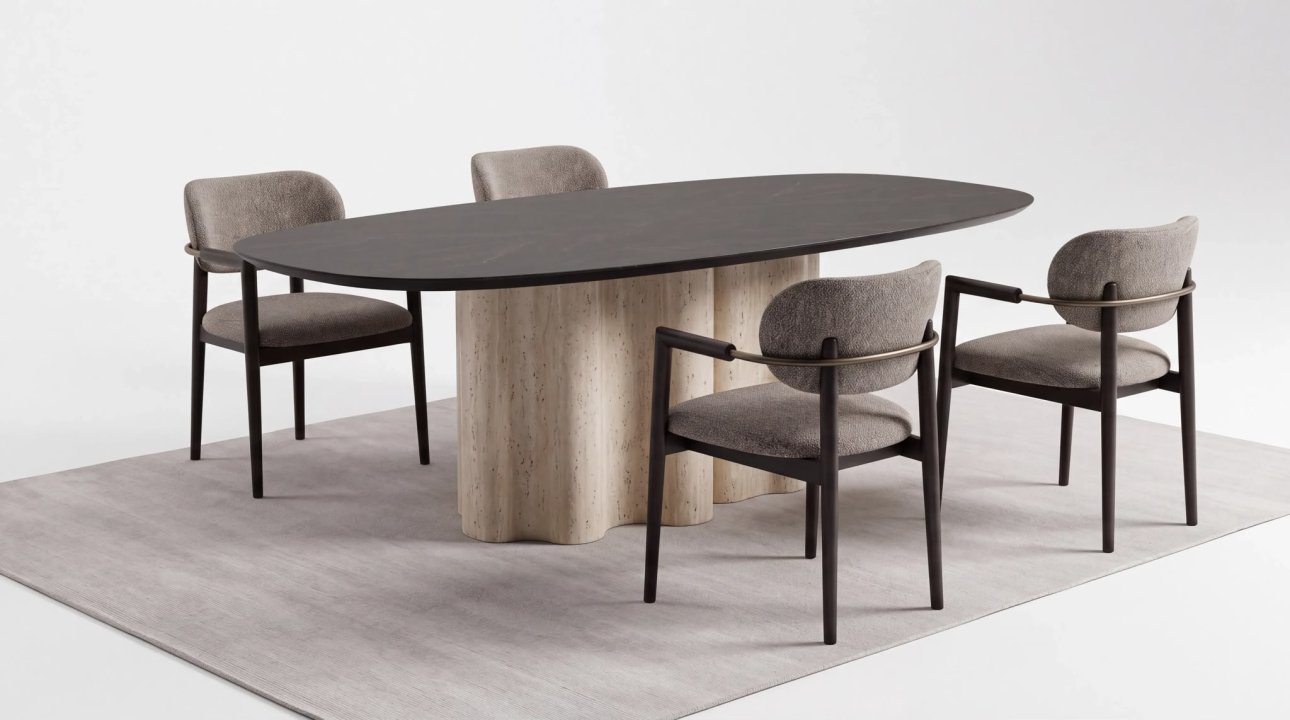
One of the questions that arises most frequently regarding the dining table is: how many people should it accommodate? The answer depends largely on the characteristics of the household members and how the table is used.
The most common question when buying a dining table is this: how many people should a dining table seat? The answer depends less on how many people live in the house and more on the size of the room and how you use the table. Even for a family of four, a six-seater is sometimes more comfortable, while in a small living room even a four-seater can make the space feel cramped.
It's very common for a table that looks great in a store or online not to look the way you expected once it's at home. That's because a table isn't judged on its own. It has chairs around it, space needed to pull those chairs out, and a wall, sideboard or doorway behind it. On top of that, a pendant light hanging above affects both the look and the use. A table bought without accounting for any of this either doesn't fit the room or ends up smaller than it should be.
In this guide we've tried to keep things simple. We'll explain how much width each person needs, what sizes tables for 4 to 12 people usually come in, how much clearance to leave around the table, and how the table shape changes its capacity. We'll also touch on when extendable tables are useful, how table height relates to chairs, and how the base design affects seating. We haven't forgotten the relationship between chandelier size and the table, either.
The measurements given here are not strict rules; they are guideline ranges widely used in the industry. The shape of your room, your chair model and your habits can make small differences. Our goal is to help you go into the room with a tape measure on your next table purchase and decide knowing exactly what you're looking for. Thinking about everyday use and entertaining guests separately also makes this decision much easier, and we'll cover that too.
How Many People Should a Dining Table Seat? The Short Answer
In short: allowing roughly 55-65 cm of table edge for each person is a comfortable starting point. It's also worth leaving at least 80-90 cm of clearance around the table so people can pull out a chair and get up. For everyday use, adding one or two seats to the number of people in the household is usually the right call.
Common size ranges by capacity
| Capacity | Rectangular table (approx.) | Round table diameter (approx.) |
|---|---|---|
| 4 people | 120-140 x 75-90 cm | 90-110 cm |
| 6 people | 160-180 x 85-95 cm | 120-135 cm |
| 8 people | 200-240 x 90-100 cm | 150-170 cm |
| 10 people | 240-280 x 95-105 cm | - |
| 12 people | 280-320 x 100-110 cm | - |
These figures are general ranges. A thick-edged tabletop or chairs with wide armrests can reduce the capacity of the same table by one person.
Everyday needs or guests?
If you host a large dinner two or three times a year, it may not make sense to choose the table you use every day based on that. It's more practical to pick a table that suits your daily routine and look at an extendable model for days with guests. If both needs come up often, you first need to measure whether the room can actually accommodate a large table. When browsing STARMOBİ's table models, we recommend considering capacity in both the closed and extended positions.
Clearance around the table
Around 70-80 cm is generally enough to pull out a chair, and around 90-110 cm if someone needs to walk behind. If nobody will sit on a side close to the wall, the distance can be smaller. If a sideboard or display cabinet has doors that open, factor in that space as well.
Table shape changes capacity
- Rectangular: The most efficient shape. People sit in a row along the long sides, and extra seats can be added at the ends.
- Oval: With no corners it feels softer and eases movement around it. But seating at the ends becomes a little tighter.
- Round: Great for conversation, but as it gets larger the serving area in the middle moves out of reach. It struggles beyond 6 people.
- Square: A tidy solution for 4 people in small rooms. Not really suited to more.
Extendable tables and custom sizes
An extendable table takes up little space on a normal day and lets you seat two or three more people when guests arrive. Models like this are available in STARMOBİ collections. If your room is non-standard, for example a long narrow living room or a space combined with the kitchen, custom-size production can be a good option. Ready-made models don't always fit every space.
Height, base design and chandelier
Dining tables are usually around 74-76 cm high. Leaving a difference of about 28-30 cm between the chair seat height and the tabletop makes for comfortable seating. If you're buying armchairs, check whether the armrests fit under the table. If they don't, each chair will need extra space.
The base design also changes the seating arrangement. Pedestal tables free up legroom and work very well with round and oval shapes. With four-legged tables, sitting at the corners can be awkward. With trestle-style models, i.e. those with two wide legs, the ends are generally easier to use. There's a practical rule for chandeliers: its diameter should be roughly between half and two-thirds of the table's short side, and it should hang 70-80 cm above the tabletop.
On materials, there are differences in weight and maintenance between wood, marble and porcelain tops, but they don't change the size decision. For care, a look at the user guide will do the job.
STARMOBİ's history began with manufacturing in 1981; the first showroom opened in 1990, and since moving into Masko in 1998 it has operated under the MEP umbrella. You can read about its approach to quality on the quality policy page.
If you'd like to see dining table models in person, you can visit STARMOBİ's Masko showroom. To get a table recommendation by sharing your room measurements, contact us through the contact page.
The Most Common Mistakes When Choosing a Dining Table
The most common mistake when choosing a dining table is deciding on size based only on the "seats X people" label. In reality, the number on a table usually reflects its capacity under the most comfortable conditions. Your room, your chairs and your habits may be different. Below we've gathered the mistakes we see most often in the field and how to avoid them.
Not Accounting for Width per Person
The industry generally recommends allowing 55-65 cm of table edge per person. Go below this range and elbows start bumping, taking the enjoyment out of the meal. The table below summarizes commonly used ranges. Treat it as a guiding framework, not a strict rule.
| Capacity | Rectangular table (approx.) | Round table diameter (approx.) |
|---|---|---|
| 4 people | 120-140 x 80 cm | 100-110 cm |
| 6 people | 160-180 x 90 cm | 120-135 cm |
| 8 people | 200-220 x 95-100 cm | around 150 cm |
| 10 people | 240-260 x 100 cm | - |
| 12 people | 280-300 x 100-110 cm | - |
Forgetting the Clearance Around It
Fitting the table into the room isn't enough; you need to be able to move around it comfortably. Leaving 90-100 cm between the table edge and a wall or sideboard generally works well. You need at least 60-70 cm to pull out a chair, and more than that if someone will walk behind. Choosing a large table for a narrow room makes everyday life harder.
Ignoring Table Shape
Put a square, oval or round table in the same space and the capacity changes. Round and oval tables have no corners, so they fit people side by side more comfortably, but in a long, narrow room a rectangular table usually makes more sense. Square tables struggle beyond four people.
Confusing Everyday Needs with Entertaining
Buying a huge table for a crowd that comes twice a year, and having it crowd the room the rest of the time, is a common choice. Decide on everyday use first, and think about guest needs separately. This is where extendable tables come in handy: normally suitable for 4-6 people, they can extend to 8 on busy days. STARMOBİ's table models include extendable options like these.
Overlooking Height, Base and Lighting
- Height: Standard table height is generally around 74-76 cm. Always check whether armchairs fit under the table.
- Base design: Pedestal tables open up legroom, while on four-legged models corner seats can get cramped. On trestle-style bases, end chairs can be harder to place.
- Chandelier: The chandelier should be a little narrower than the table; roughly two-thirds of the table length is a good starting point, and hanging it 70-80 cm above the tabletop generally works well.
- Material: Choosing a wood, marble or porcelain top is a matter of looks and maintenance; it comes after the size decision.
Forcing a Standard Size
If your room isn't standard, consider custom production instead of searching for a ready-made size. In spaces with niches, narrow or asymmetrical layouts, a made-to-measure table both fits and looks balanced.
STARMOBİ began with manufacturing in 1981, opened its first showroom in 1990, and has been operating at Masko under the MEP umbrella since 1998. When choosing products, we care about comfort of use as much as size; you can find this approach on our quality policy page. For caring for your table, we recommend taking a look at the user guide.
If you'd like to see the models up close before deciding, you can stop by STARMOBİ's Masko showroom. To get a table recommendation based on your room size, contact us through the contact page.
How Much Table Width Does Each Person Need?
The short answer: allowing about 55-65 cm of width per person at a dining table provides a comfortable seating arrangement. This figure is a guideline range widely used in the industry, not a strict rule. Whether the chair has armrests, the table's shape and the room's size can change the result slightly.
How Many Seats, What Size?
The ranges below give a general idea for rectangular tables. They may vary by manufacturer and model.
| Capacity | Common length | Common width |
|---|---|---|
| 4 people | 120-140 cm | 70-90 cm |
| 6 people | 160-180 cm | 80-90 cm |
| 8 people | 200-220 cm | 90-100 cm |
| 10 people | 240-260 cm | 100-110 cm |
| 12 people | 280-320 cm | 100-120 cm |
Leave Clearance Around the Table
Choosing the right table is half the job. The other half is the space around it. To pull out a chair and sit down comfortably, there should be at least 90 cm, and preferably 100-110 cm, between the table edge and a wall or another piece of furniture. If someone will walk behind, this distance increases a bit more. If your room is narrow, measure the floor area first, then decide on the table.
Capacity Differences by Shape
Rectangular tables fit the most people along their long sides. Oval tables feel softer because they have no corners, but seating at the ends is slightly reduced. Round tables are great for conversation with 4-6 people, but as they get larger, reaching the dishes in the middle becomes harder. Square tables are generally designed for 4 people. Large square models can seat 8, but the center of the table ends up too far away.
Extendable Tables, Height and Base Design
If 4 people sit at the table day to day and guests come once or twice a month, an extendable table is a sensible solution. It doesn't take up space on normal days and extends on busy ones. When looking at table models, be sure to try out the mechanism on extendable options.
Table height is usually around 75-76 cm. A difference of about 28-30 cm between the chair seat height and the table gives a comfortable balance. Check in advance whether armchairs will fit under the table. Otherwise they'll stay at the table's edge at every meal.
The base design also affects capacity. Pedestal tables rarely cause knocked knees and allow more flexible seating around them. On four-legged tables, the legs at the corners can narrow the space of the person at the end. On trestle-style or wide-base models, you need to pay attention to leg spacing.
Chandelier and Table Size
A chandelier's diameter is generally chosen between one-third and one-half of the table's width. Hanging it about 70-80 cm above the tabletop balances the light and doesn't block your view of the person opposite.
Decide Based on Your Own Needs
Think about everyday use first. Then consider how many times a year you set a large table. In most homes the daily need is 4-6 people, and an extendable model handles guest days. If the room isn't standard, custom-size production can also be a good option. In situations like niches, columns or sloped walls, the table is made to fit the room exactly.
A brief word on materials: wood gives a warm look, while marble and porcelain tops offer a more durable and cleaner surface. For care, it helps to look at the recommendations in the user guide.
STARMOBİ, as one of the standout options, offers table models in different sizes. The brand started out with manufacturing in 1981, opened its first showroom in 1990, and in 1998 moved into Masko and began operating under the MEP umbrella. You can find models that match these size ranges in the collections. If you're curious about its approach, the quality policy page is also useful.
If you'd like to see the table in person, you can visit STARMOBİ's MEP-certified Masko showroom. You can also reach out through the contact page to share your room measurements and get a table recommendation that suits you.
Table Depth and the Central Serving Area
When choosing a table, everyone looks at the length first and depth stays in the background. Yet it's often depth that determines whether a table setting is comfortable. In the industry, the common range for dining tables is about 90 to 100 cm; this leaves a reasonable plate area per person while also opening up space in the middle.
Why does the central serving area matter?
After setting plates, glasses and cutlery in front of two people sitting opposite each other, there should be a strip left in the middle of the table. For a serving platter, a jug, a bread basket and a small decorative piece, this strip should be roughly 30-40 cm. On a narrow 80 cm table, this area barely exists and plates crowd each other. At a depth of 110 cm and above, passing something to the person opposite becomes harder, and the conversation drifts a bit further apart too.
| Table depth | Typical use |
|---|---|
| 80-85 cm | Narrow kitchens and small living rooms, everyday use |
| 90-100 cm | A balanced size for most homes |
| 100-110 cm | Large gatherings, plenty of serving dishes |
These aren't strict rules but guideline ranges. The room's shape and the chair type always shift the size somewhat.
Depth and the room
Making the table deeper means taking space from the room. If you increase depth without accounting for chair pull-out space and walkway clearance, it may become impossible to pass behind someone once they're seated. That's why it's healthier to measure the room first and then decide on the table. For those who want a wide serving area in the middle but have a narrow room, meeting the same capacity with a slightly longer, slimmer table often makes more sense.
If you'd like to see which models come in different depths and shapes, you can find options matching these ranges among STARMOBİ's table models. If your room doesn't fit standard sizes, custom-size production can also be a practical way to set the depth exactly to your needs.
Extra Allowance for End Chairs
The detail most often overlooked in table size calculations is the people sitting at the two short ends of the table. It's easy to allow 60-70 cm per person along the long sides and call it done, but those at the ends need to be considered separately. The end chair is often used as the head seat, and that person makes eye contact with the guests on both sides as well as opposite. A table that's too narrow at that point is both uncomfortable and spoils the look.
In practice, leaving roughly 20-30 cm of extra allowance in table length for end chairs works well. This keeps the chair from being squeezed into the corner of the table and stops the side guest's knee from bumping into the person at the end. This is a guideline range commonly used in the industry, not a strict rule. The chair's width and whether it has armrests change the result.
Which tables does this matter for?
- Rectangular tables: If you want chairs at the ends, this is the shape where you need extra allowance most. On a six-seater with two end chairs, three people rather than four sit along each long side, and the length is calculated accordingly.
- Oval tables: Since the ends are rounded, chairs can slide slightly inward. The need for extra allowance drops a little, but you should still check that the person at the end has room for their feet.
- Round and square tables: With no distinct ends, this calculation doesn't apply here. The size is determined by the perimeter.
Table base design also comes into play here. On models with legs at all four corners, the end chair can hit the legs. With pedestal or recessed-leg designs, the ends can be used much more freely. If you're thinking of buying armchairs, also check whether the armrests fit under the table.
If you're undecided, you can browse STARMOBİ table models to pin down the right table size for your room. Moving up a size once you factor in the end-chair allowance can sometimes seem unnecessary, but in everyday use the difference is clearly felt.
Dining Table Sizes for 4, 6, 8, 10 and 12 People
In short, allowing about 55-65 cm of table width per person is a widely accepted range for comfortable seating. On that basis, 4-seat tables are usually 90-140 cm long, 6-seat tables 160-180 cm, and 8-seat tables 200-240 cm. 10- and 12-seat models go to 260 cm and beyond. These aren't strict rules but guideline ranges commonly used in the industry.
Common sizes by capacity
| Capacity | Rectangular table (length x width) | Round table (diameter) |
|---|---|---|
| 4 people | 120-140 x 80-90 cm | 100-110 cm |
| 6 people | 160-180 x 90 cm | 130-150 cm |
| 8 people | 200-240 x 95-100 cm | 160-180 cm |
| 10 people | 260-280 x 100 cm | - |
| 12 people | 300-340 x 100-110 cm | - |
Clearance around the table
Looking only at the tabletop size when buying a table is a common mistake. Between the table and a wall or sideboard, there should be enough room to pull out a chair and sit down. Around 60-70 cm to pull out a chair, and around 90-100 cm for someone to walk behind comfortably, is a good target. If your room is narrow, think of the tabletop size reduced by this much on every side.
Table shape changes capacity
In the same space, a rectangular table seats the most people. An oval table is easier to move around because it has no corners, but seating along the edges narrows slightly. A round table is lovely for conversation, but as it grows, reaching the plates in the middle becomes harder. Square tables are generally 4-seaters; wider ones can go up to 8 people.
Height, base design and extendable tables
Standard table height is around 74-76 cm. If your chairs have armrests, make sure they fit under the table, otherwise the chair will always sit halfway out. Pedestal and trestle-style tables avoid leg clashes, making seating more flexible. On four-legged tables, the legs at the corners can restrict seating slightly.
Extendable tables are useful for needs like 4-6 people day to day and 8 when guests come. STARMOBİ's table models include options like these.
Chandelier and material
The chandelier should sit at least 15-20 cm inside the table's edges and be roughly two-thirds of its width. The tabletop material (wood, marble, porcelain) doesn't change the size decision; it's more a matter of looks and maintenance. For care, you can take a look at the user guide.
Everyday needs or guests?
If 3-4 people sit at the table every day, buying a 10-seater for guests who come a few times a year will overwhelm the room. Choosing based on everyday needs and opting for an extendable model makes more sense. If your room isn't standard, custom-size production is a good solution, because the table is designed around the walls and furniture. STARMOBİ's collections include models in different sizes.
STARMOBİ has a history that began with manufacturing in 1981. It opened its first showroom in 1990, and in 1998 moved into Masko and began operating under the MEP umbrella. If you'd like to see dining tables in person at the Masko showroom, or share your room measurements through the contact page to get a table recommendation that suits you, our team will be happy to help.
Dining Table Sizes for 4 and 6 People
Short answer: when choosing a dining table, leaving about 60–70 cm of width per person is a good starting point. On that basis, 4-seat tables are generally 120–140 cm long, and 6-seat tables 160–200 cm. But these figures aren't strict rules; they're guideline ranges commonly used in the industry.
Sizes for a 4-seat table
For a rectangular four-seat table, a length of 120–140 cm and a width of 70–90 cm works comfortably in most homes. It's ideal for a small kitchen nook or a dining area at one end of the living room. If you prefer round, a diameter of 100–110 cm is enough for four people. For a square table, a side length of 90–100 cm is a reasonable range.
Sizes for a 6-seat table
Six-seat rectangular tables are commonly 160–200 cm long and 80–95 cm wide. If you're considering a round table, a 130–150 cm diameter is sufficient, though reaching the middle of the table can become a little harder. Oval shapes offer similar capacity, and since they have no corners they allow a bit more flexibility between chairs.
| Capacity | Rectangular (length x width) | Round (diameter) |
|---|---|---|
| 4 people | 120–140 x 70–90 cm | 100–110 cm |
| 6 people | 160–200 x 80–95 cm | 130–150 cm |
Small details that affect size
- Chair pull-out space: Leaving at least 90 cm between the table edge and a wall or furniture, or 100–110 cm if you want comfortable passage, makes things easier.
- Height: Table height is usually around 74–76 cm. Always check that armchairs fit under the table.
- Base design: Pedestal or trestle-style tables avoid leg clashes, so the corners can be used for seating too. On four-legged models, corner seating is a little tighter.
- Everyday and guest needs: If four people eat at the table most days but it occasionally gets crowded, an extendable 4–6 seat model can be a smart solution.
The chandelier hanging above the table should also be taken into account. As a general rule, the chandelier is about two-thirds of the table's width and hangs 70–80 cm above the tabletop.
If you'd like to explore models that fit these sizes, STARMOBİ's table models include both 4- and 6-seat options. If your room doesn't fit standard sizes, custom-size production is also worth considering; this way the table fits perfectly against the wall or window, with no wasted space.
Dining Table Sizes for 8, 10 and 12 People
For large gatherings, the general rule is to allow 60-70 cm of edge length per person. The ranges below are guidelines commonly used in the industry, not strict rules.
| Capacity | Length (cm) | Width (cm) | Recommended room length (cm) |
|---|---|---|---|
| 8 people | 200-240 | 90-100 | about 400 and above |
| 10 people | 260-300 | 100-110 | about 460 and above |
| 12 people | 300-360 | 105-120 | about 500 and above |
How much space should be left around the table?
You need at least 90 cm between the table and a wall or sideboard to pull out a chair and sit down. If someone will walk behind, 100-110 cm is more comfortable. The "room length" value in the table includes this allowance.
Shape, base design and extendable tables
Oval and round tables have no corners, so at the same length they comfortably seat one or two more people. With square and rectangular tables, the ends are used more efficiently. On four-legged models, the leg of the person at the corner may line up with the table leg. Pedestal or trestle-style bases allow flexible seating along the edge, which is why they're often preferred for 10- and 12-seat tables. If 4-6 people sit at the table day to day and guests come a few times a month, an extendable table is a sensible solution. Closed, it saves space; extended, it seats 8-10. Dining table ranges include extendable options like these, and STARMOBİ collections are among them.
Height, chairs and chandelier
Standard table height is around 74-76 cm. Always check whether armchairs fit under the table; otherwise the chair will always sit a little too far away. Hanging the chandelier about 75-90 cm above the tabletop and choosing a width of about one-third of the table works well. On long tables, two or three small pendants instead of one large chandelier keep the visual balance.
If your room isn't standard, custom-size production is the best route. On the material side, choosing a wood, marble or porcelain top is a detail that comes after size.
Conclusion
The right dining table size is determined first by the actual dimensions of the room, then by how your table is set. A 60-70 cm edge allowance per person, 90-100 cm of walkway clearance around the table and a height of around 74-76 cm draw a solid framework to start with. A length of 200-240 cm for an 8-seat table, 260-300 cm for a 10-seat table and 300-360 cm for a 12-seat table is a reasonable starting point. Still, these are general ranges commonly used in the industry, and the position of your room's doors and windows can change these figures.
When deciding, ask yourself two questions: how many people sit at the table every day, and how many times a year do you set a large table? If the daily need is 4-6 people and guests come occasionally, an extendable table provides flexibility without losing space. Shape and base design also affect capacity. An oval or pedestal table can offer more comfortable seating at the same length. Taking the chandelier and chair armrests into account from the start reduces surprises later. If your room doesn't fit standard sizes, custom-size production is also a serious option.
STARMOBİ's history began with manufacturing in 1981, and the first showroom opened in 1990. Since moving into Masko in 1998, work has continued under the MEP umbrella. You can take a look at the user guide for product care.
The next step is simple: take your room measurements and mark the area where you plan to place the table with tape. Then you can examine the models in person at STARMOBİ's Masko showroom, or share your room measurements through the contact page and ask for a table recommendation that suits you.
Güncellendi: Ekim 2026